The pace you need
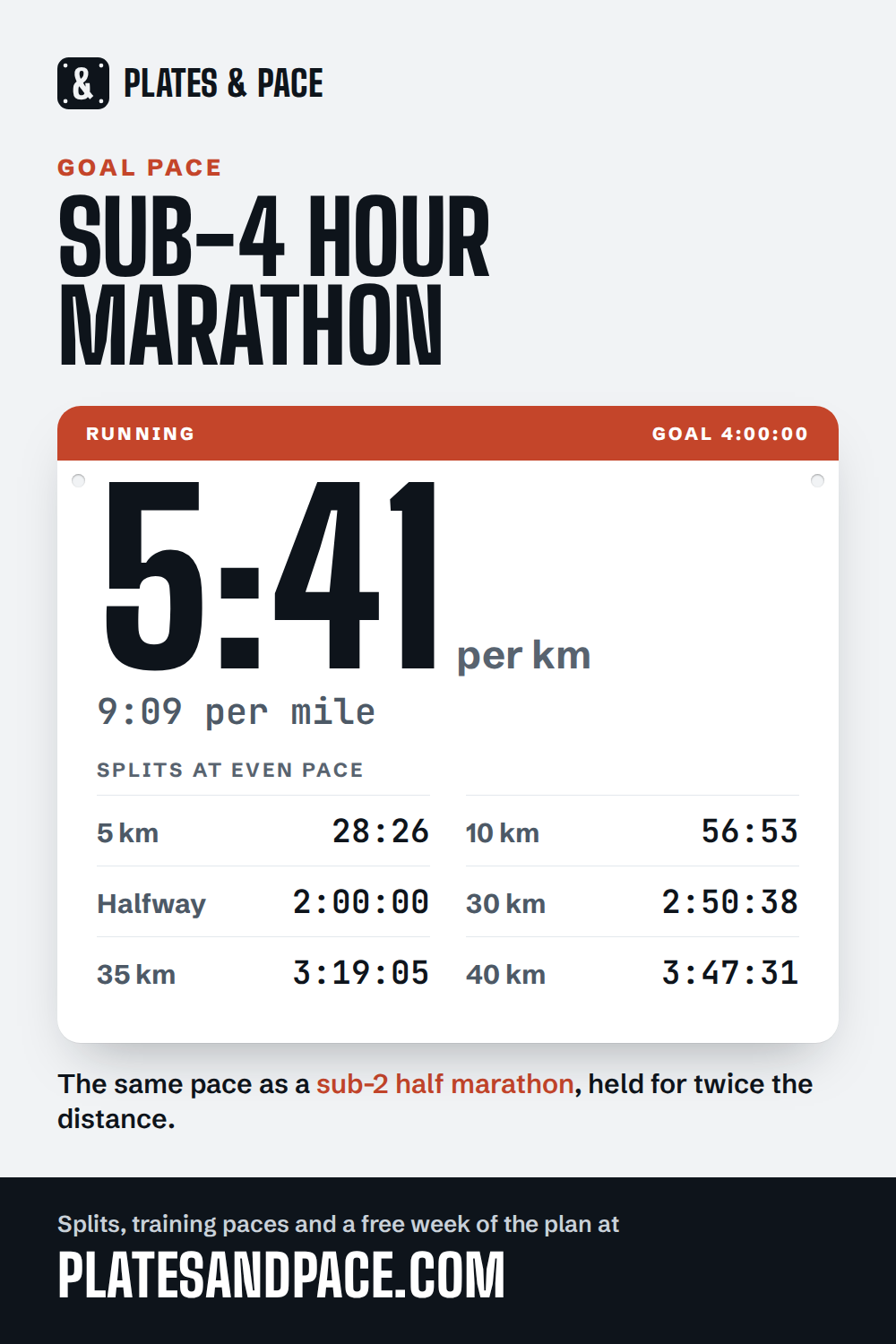
A sub-4 marathon needs 9:09 per mile or 5:41 per kilometer, the pace of a 2-hour half marathon held for twice the distance.
| Measure | Per mile | Per km |
|---|---|---|
| Pace to hold | 9:09 | 5:41 |
| Finish at that pace | 3:59:55 | 3:59:49 |
| Exact pace | 9:09.2 | 5:41.3 |
| Speed | 6.6 mph | 10.5 km/h |
| Halfway at even pace | 2:00:00 | |
The paces to hold are rounded down to the second, so holding them gets you home on the goal or just inside it. Finish times are rounded up to the next whole second, as road race results are.
Checkpoint times
What your watch should read at each marker for an even-paced race, and for a plan where the second half is 2% faster than the first. A 2% negative split means going through halfway in 2:01:13 and running the second half in 1:58:47.
| Checkpoint | Even pace | 2% negative split |
|---|---|---|
| 5 km | 28:26 | 28:57 |
| 10 km | 56:53 | 57:45 |
| 15 km | 1:25:19 | 1:26:26 |
| 10 miles | 1:31:32 | 1:32:41 |
| 20 km | 1:53:45 | 1:54:58 |
| Halfway | 2:00:00 | 2:01:13 |
| 25 km | 2:22:12 | 2:23:22 |
| 30 km | 2:50:38 | 2:51:38 |
| 20 miles | 3:03:05 | 3:03:57 |
| 35 km | 3:19:05 | 3:19:46 |
| 40 km | 3:47:31 | 3:47:45 |
| Finish | 4:00:00 | 4:00:00 |
How to pace a sub-4 marathon
- Go through 10 km in about 56:53 and halfway in 1:59:00 to 2:00:00.
- Walk through water stations if you need to, and make the time back gradually, not in one kilometer.
- The stretch from 30 to 38 km is the one to prepare for. Hold 5:41 per kilometer there and the finish is within reach.
Want the numbers on your wrist? The pace band generator prints a strip with the elapsed time at every kilometer or mile.
Training paces for this goal
A sub-4 marathon scores a VDOT of about 37.9 on the scale from Jack Daniels’ Running Formula. These are the training paces that go with that score, using Daniels’ intensities: easy running at 59 to 74% of VO2 max, threshold at 88% and intervals at 97.5%.
| Session | Per mile | Per km |
|---|---|---|
| EasyMost of your weekly running, including long runs | 9:49 to 11:44 | 6:06 to 7:17 |
| MarathonSteady segments of long runs | 9:09 | 5:41 |
| ThresholdTempo runs of about 20 minutes, or cruise intervals | 8:33 | 5:19 |
| IntervalRepeats of 3 to 5 minutes with jog recovery | 7:53 | 4:54 |
Train at the paces for the fitness you have now, not the goal. If your recent races are slower, use the VO2 max calculator with a recent result and move to these paces as your races improve.
16-week sub-4 marathon training plan
Built on the training paces above: 5 runs a week, a peak week of 59 km and a longest run of 29 km. Paces start two VDOT points below the goal and move up to goal pace over three phases, with a half marathon tune-up in week 12 and a two-week taper before race day.
It suits you if
- You run about 5 times a week, around 37 km in total.
- Your longest run in the last month is at least 13 km.
- A recent race of about 2:01:34 for the half marathon or 54:50 for the 10K. The paces start there and move up to the goal pace.
Week 1 and a week from the build phase, free
| Day | Session | Distance |
|---|---|---|
| Mon | Rest | |
| Tue | Easy 6 km6:22 to 7:36 /km, then 6 × 20 s strides | 6 km3.7 mi |
| Wed | Easy 5 km6:22 to 7:36 /km | 5 km3.1 mi |
| Thu | Easy 6 km6:22 to 7:36 /km, then 6 × 20 s strides | 6 km3.7 mi |
| Fri | Rest | |
| Sat | Easy 5 km6:22 to 7:36 /km | 5 km3.1 mi |
| Sun | Long run 15 kmEasy, 6:22 to 7:36 /km | 15 km9.3 mi |
| Day | Session | Distance |
|---|---|---|
| Mon | Rest | |
| Tue | Threshold: 3 × 2 km2 km easy, then 3 × 2 km in 10:52 each (5:26 /km) with 2 min easy jogging between, 1.5 km easy | 10 km6.2 mi |
| Wed | Easy 5 km6:14 to 7:26 /km | 5 km3.1 mi |
| Thu | Marathon pace 7 km2 km easy, 7 km at marathon pace (5:49 /km), 1 km easy | 10 km6.2 mi |
| Fri | Rest | |
| Sat | Easy 5 km6:14 to 7:26 /km, then 6 × 20 s strides | 5 km3.1 mi |
| Sun | Long run 23 kmEasy, 6:14 to 7:26 /km | 23 km14.3 mi |
Easy means conversational. If a session feels far too hard, use the paces for your current fitness from the VO2 max calculator and move up as you improve.
Full plan
All 16 weeks, with the paces for this goal
- Every session, week by week, in km and miles (PDF)
- A calendar file set to your race date for Google, Apple or Outlook
- A printable pace band for race day
Race times that match this goal
The same VDOT gives these times at other distances. If you have run close to them recently, the goal is within reach on equal training. For the marathon, treat these as the minimum: the formula assumes training suited to the marathon, including long runs of 30 km or more, and without it the marathon can come out slower than shorter races predict.
| Race | Time | Per mile | Per km |
|---|---|---|---|
| 5K | 25:14 | 8:07 | 5:02 |
| 10K | 52:22 | 8:25 | 5:14 |
| Half marathon | 1:56:06 | 8:51 | 5:30 |
Save this pace card
Questions
What pace is a sub-4 marathon?
9:09 per mile or 5:41 per kilometer. Holding exactly 9:09 per mile gets you to the finish in 3:59:55, and 5:41 per km gets you there in 3:59:49.
What is the halfway split for a sub-4 marathon?
2:00:00 at even pace. With a 2% negative split, go through halfway in 2:01:13 and run the second half in 1:58:47.
What treadmill speed is sub-4 marathon pace?
10.5 km/h or 6.6 mph. A 1% incline makes up for the lack of air resistance on a treadmill at this speed (Jones and Doust, 1996).
What 5K time do I need for a sub-4 marathon?
About 25:14 on equal fitness, from the Daniels and Gilbert formula behind Daniels’ VDOT tables. A half marathon of 1:56:06 is the better guide for the marathon.
How do I train for a sub-4 marathon?
Build most of your week from easy running at 6:06 to 7:17 per km, with one threshold session near 5:19 per km and a weekly long run. Run the goal pace itself in shorter sections so it feels familiar on race day.
Add this calculator to your site
Running club, coach or blog? You can put this calculator on your own site for free. Copy the code below into your page’s HTML. The calculator updates itself whenever we improve it.
The short script lets the frame grow to fit the calculator on your page. Please keep the credit line underneath it.
Sources
- Daniels J. Daniels’ Running Formula. 4th ed. Human Kinetics; 2022. VDOT tables and training intensities.
- Daniels J, Gilbert J. Oxygen Power: Performance Tables for Distance Runners. 1979.
- Jones AM, Doust JH. A 1% treadmill grade most accurately reflects the energetic cost of outdoor running. Journal of Sports Sciences. 1996;14(4):321-327.
- Bosquet L, Montpetit J, Arvisais D, Mujika I. Effects of tapering on performance: a meta-analysis. Medicine & Science in Sports & Exercise. 2007;39(8):1358-1365. Basis for the two-week taper.
- World Athletics. Competition Rules and Technical Rules (Book C, C1.1 and C2.1). Technical Rule 19, Timing and Photo Finish: times in races held outside the stadium are recorded to the next longer whole second.